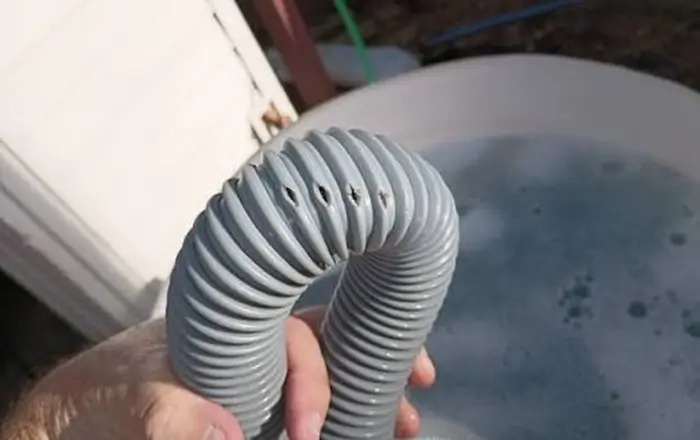
 To unclog a curved vacuum hose, disconnect the hose from the vacuum and work from whichever opening is closest to the blockage.
Try tapping and flexing the hose first. If the clog won’t move, use a long, flexible, blunt tool that can follow the bend without puncturing the hose.
A clog in the curved section of a vacuum hose can be really difficult to remove. The blockage often gets wedged inside the bend at the handle or in the elbow section that attaches to the vacuum.
First, Find Where the Hose Is Blocked
Unplug the vacuum and remove the hose and handle assembly if possible. Look into both ends with a flashlight.
Clumps of hair, paper, stray socks, small toys, and other bulky objects often get stuck where the flexible hose meets the handle.
If you can’t see anything at either end, gently squeeze and flex the hose, feeling your way along the length of the hose with your fingers. If the blockage is inside the flexible part of the vacuum hose, you’ll feel a stiff or lumpy area.
Don’t forget to look inside any attachments you were using with the hose. Your crevice tool or upholstery brush could be hiding the blockage.
How to Unclog a Blockage in the Curved Handle
Hold the hose with the opening facing toward the floor and shake or tap the curved section. If the object is only loosely wedged, gravity and a firm shake may be enough to remove it.
Next, flex or massage the flexible hose area right next to the curved handle or hose elbow. This can loosen packed hair or debris or change the position of a solid object enough to get it to come out.
What Can You Use to Remove a Clog From a Curved Vacuum Hose?
For a clog close to an opening, you might be able to reach the blockage with your fingers or a pair of long-nosed pliers without inserting anything deep into the hose.
For a deeper blockage, using a flexible plastic rod or similar blunt tool is safer than digging around with a screwdriver, metal rod, or other sharp object that might damage the hose.
Another option is a flexible grabber claw. These tools have a long, flexible shaft with a small retractable claw at the end. Because the shaft bends, it can follow the curve of the vacuum hose, grab hold of the clog, and pull it out.
A flexible grabber isn’t usually sold as a tool for unclogging vacuum cleaners. Search for “drain snake,” “flexible grabber tool,” or “drain clog remover tool.”
These inexpensive tools are a handy addition to any home toolbox and make it easy to clear clogs from other hard-to-reach areas, like sink and bathtub drains, dryer vents, and downspouts.
Safety Notes!
Unplug the vacuum before removing the hose or reaching near its inlet. Avoid screwdrivers, bare wire, sharp hooks, and other objects that can puncture the hose or damage wiring inside a hose with a power switch on the handle.
How to Unclog the Flexible Part of the Vacuum Hose
If the blockage is farther down the flexible part of the vacuum hose, you have more options.
Remove the hose and straighten it gently without stretching it. Try shaking the obstruction towards the nearest end.
For a straight hose, you can use a broom handle, long stick, or narrow plastic tube to push the blockage out.
What If the Clog Won’t Come Out?
Check if the curved handle, cuffs, wand, or hose ends can be detached. On some vacuums, separating these components will give you more direct access to the obstruction.
Where the manufacturer has made these parts removable, you can usually detach them by unclipping or twisting. Check your owner’s manual before removing screws.
Some hose handles contain electrical wiring for power and suction strength buttons, and taking them apart can cause damage.
Water can sometimes dislodge a stubborn clog, but you should only use water in hoses that are safe to wash. Never run water through a powered handle!
If you have an air compressor, a blast of air may dislodge the clog.
Try using a shop vac to suck the blockage out. Shop vacs are designed to handle larger debris and shouldn’t create a new blockage in the shop vac hose.
If the blockage still won’t move, take the vacuum to a repair shop where they have the right tools to deal with clogged hoses.
How to Prevent Vacuum Hose Clogs
Pay attention when you’re vacuuming around sofas, beds, kids’ rooms, and laundry rooms. Socks and small toys are notorious for causing vacuum hose clogs, and they’re so easy to accidentally suck up.
Before you vacuum, pick up any obvious potential clog hazards, like paper, hair clips, plastic wrappers, Legos, and pens.
Keep your vacuum clean to maintain good airflow and strong suction. Regularly inspect your filters and empty your tank before it gets too full.
Strong suction helps to pull debris through the hose rather than leaving it stuck in a hard-to-reach spot.
FAQs
How do you know if a vacuum hose is clogged?
Sudden loss of suction, a change in the vacuum’s sound, debris falling back out of the hose, or strong suction at the vacuum but weak suction at the hose are all signs of a blockage.
Can you use a broom handle to unclog a vacuum hose?
Yes, if the clog is in a wide, relatively straight, flexible hose, a broom handle is a quick way to unclog it. But a broom handle can’t get around the tight bend inside a curved vacuum hose, so a flexible tool is needed.
Can you run water through a vacuum hose to unclog it?
Yes, but only if the hose is washable and contains no electrical wiring, switches, or powered connections. Check the manufacturer’s instructions first and let the hose dry completely before use.
Can a clogged hose damage a vacuum?
A blockage will restrict airflow and make the vacuum run hotter than normal, which can damage the motor. If suction suddenly drops, switch the vacuum off and find the blockage before continuing to use it.